VCL Products > Automatic Protection Switch > 8 T1 Links (24 T1 Ports)
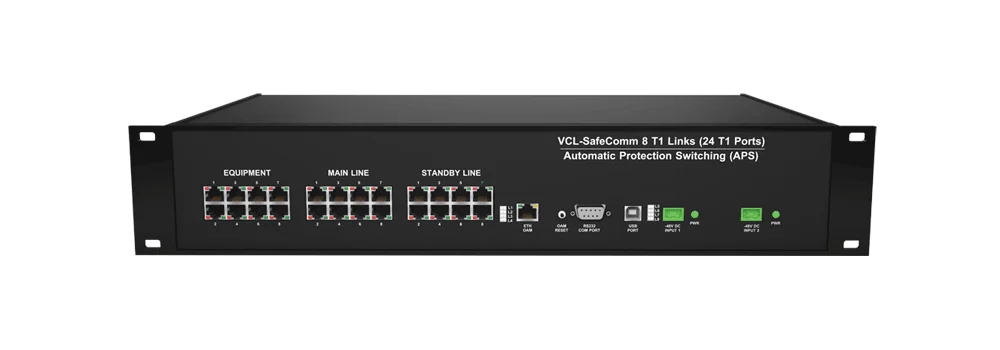
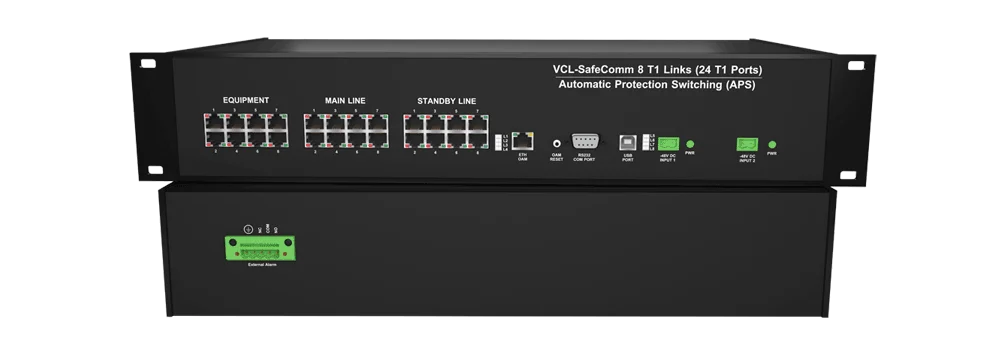
Failsafe - The equipment itself never becomes a point of failure. It automatically reverts to and reconnects to the primary link even in power down condition.
8 T1 Links (24 T1 Ports), 1+1 Automatic Protection /
AB Fallback Switching Equipment
The VCL-SafeComm, 8 T1 Links (24 T1 Ports), 1+1 Automatic Protection / AB Fallback Switching (APS) Equipment may be used to protect upto 8 T1 Links (24 T1 Ports), point-to-point links and provide an alternate communication route to each T1 Link between any two T1 points. In the event of the failure of the primary (Main) T1 communication route, the VCL-SafeComm, 8 T1 Links (1+1 Automatic Protection / AB Fallback Switching Equipment) automatically switches the T1 traffic to a secondary (standby) T1 route. The VCL-SafeComm, 8 T1, 1+1 Automatic Protection / AB Fallback Switching equipment is available in a 2U high chassis which may be mounted in any DIN standard,19-Inch rack.
SafeComm 8 T1 Links 24 T1 Ports Fallback SwitchingThis product allows the user to design 1+1 (protected) redundant T1 routes on similar (fiber-fiber), or complementing (fiber-radio) transmission mediums.
The criterion for switching between the primary (main) and the secondary (protected / standby) routes is user programmable. Criterion for switching between the primary (main) and the secondary (protected / standby) routes may be Loss-Of-Signal on T1 links, or AIS (All-Ones AIS alarm) condition. The criterion for switching time and recovery time between the primary (main) and the secondary (protected / standby) routes is user programmable.
Data transported on the T1 Links is transparent and protocol independent.
Salient Features
- One of the salient features of the VCL-SafeComm 1+1 Protection Switch is that it does not "add" a point-of-failure to the T1 network.
- Even in the event that the power to the VCL-SafeComm 1+1 Protection Switch fails or the power to the equipment is disconnected and removed or the equipment itself fails, the T1 link connectivity shall be "always" maintained." The T1 link integrity is ALWAYS maintained (the switch reverts the connection to the primary T1 link). This ensures that the T1 link connectivity is never lost.
- VCL-SafeComm 1+1 Protection Switch provides two power inputs and this allows the user to connect the switch to two separate independent - 48V DC power sources to minimize the chances of any power failure occurring due to power outage.
Features & Highlights
- High density protection switching equipment (upto 8 T1 Links i.e. 24 T1 Ports)
- To provide an independent point-to-point, protected T1 Link between two "T1 USER PORTS" on similar (example fiber-fiber), or dissimilar (fiber-radio) mediums
- To provide 1+1 T1 redundancy support to higher order multiplexers e.g. E2, E3
- System configuration and management interface through "CLI" text based commands
- Transport A-bis Interface on redundant T1 links
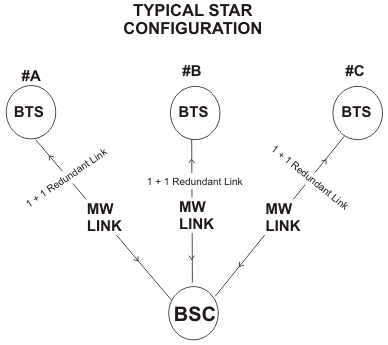
- Provide 1+1 Protection Routing / Path between BSC and BTS
- Through the comprehensive remote configuration and alarm management capabilities of the VCL-SafeComm, 8 T1, 1+1 Automatic Protection / AB Fallback Switching Equipment the product may be used to improve network reliability and control
- These ensure that mission critical voice, data, control and management traffic are properly supported and maintained even during T1 backhaul facility outages. When the primary (working) link fails, the T1 traffic is automatically switched to the standby (secondary) link to ensure maximum uptime
- Traffic Protection
- Alternate Facility Advantages
- Service Differentiation Agreements
- Increased Network Reliability Resilience
- Media and Path Diversity
- Remote Management
- Alarm logging and monitoring.
Benefits
- Customer Relations
- Competitive
- Service Level
- Back-haul Network
- Technology Migration
- User Programmable 1+1 Protection Parameters:
- Loss of Signal
- AIS (All Ones Alarm)
Applications
Providing 1+1 alternate paths between any two Transmission mediums (active+standby). e.g:
- Fiber/Fiber
- Radio/Fiber
- Radio/HDSL
- Fiber/HDSL etc.
Example: The user may deploy the VCL-SafeComm, 8 T1, 1+1 Automatic Protection / AB Fallback Switching Equipment to provide an alternate communication route between an optical fiber link and a radio link between any two points. In the event of the failure of the primary (optical fiber) link the T1 is automatically switched to the alternate route over the T1 radio, thus ensuring maximum uptime on all such 1+1 protected T1 Links.
Once the primary (optical fiber) T1 Link on the optical fiber is restored, the VCL-SafeComm, 8 T1, 1+1 Automatic Protection / AB Fallback Switching Equipment automatically restores the communication to the primary (optical fiber) T1 Link. The switching and restoration criterion is user programmable.
Application Diagrams # 1
Features
- 1+1 Link Protection
- Radio + Fiber Media Protections
- Under 50ms switch over time
- Continous E1 Link Status Monitoring
- Designed for disaster recovery and Mission critical applications
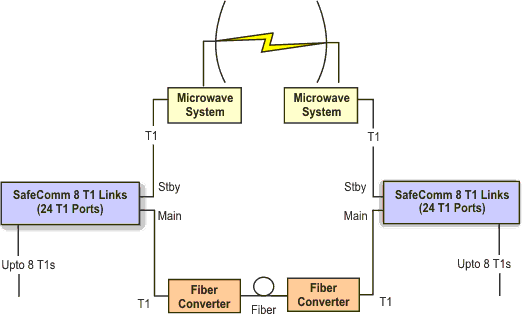
Point-to-Point Application: May be used in a point-to-point configuration to provide 1+1 protected / Alternate Routing Path between any two point, using diverse (or similar) T1 transmission mediums.
Application Diagrams # 2